Ph.D. Scholarships in the Humanities, Social Sciences, Economics, and Law
Uncertainty
We live in a time of global uncertainty. As individuals, groups, and societies, we are increasingly confronted with turbulent events and developments that leave us with an unpredictable future and insufficient grounds on which to base our actions.
In response to these contemporary challenges, the ZEIT STIFTUNG BUCERIUS has established the international scholarship program "Uncertainty." This initiative brings together diverse perspectives from the humanities, social sciences, economics, and law to shed light on this complex global issue.
The program fosters innovative ideas, interdisciplinary exchange, and mutual learning through dedicated workshops and annual conferences. In support of the researchers catalyzing these vital conversations, we offer scholarships for different stages of Ph.D. research, creating a vibrant network for academic growth.
- For advanced master’s students and Ph.D. students at an early stage of project formulation
- Duration: six months
- Monthly living stipend of € 1,400
- Dissertation proposal development workshop
- For Ph.D. students enrolled in Ph.D. programs or undertaking a (formally) supervised Ph.D. project
- Duration: one to three years
- Monthly living stipend of € 1,600
- Yearly students’ conference in Hamburg, Germany
- For advanced Ph.D. students
- Duration: one year
- Monthly living stipend of € 1,600
- Yearly students’ conference in Hamburg, Germany
Applications
We invite applications from Ph.D. students worldwide from the disciplines of the humanities, the social sciences, economics and the law who are studying various facets of uncertainty. Both empirical research based on extensive fieldwork as well as projects centered on historical and theoretical reflection are eligible for support. Innovative and challenging research questions as well as comparative approaches are highly welcome. Projects can be interdisciplinary or rooted in a specific discipline. As an international program premised on scholarly exchange and collaboration, English will be the language used throughout the course of the fellowship program. Application documents can be submitted in English or German.
The third Call for Applications was published in June 2026 and is now closed.
Contact:
Dr. Anna Hofmann, Director/Head of Research and Scholarship, hofmann@zeit-stiftung.de
Terms of Reference
FAQ
Dissertation Proposal Development Workshop in Jena
How do we research uncertainty while coping with its rise within academia? A workshop at the Imre Kertész Kolleg Jena held from 15 to 17 April 2026 tackled this challenge, bringing together “Uncertainty” fellows and Ph.D. students from the Invisible University for Ukraine at Central European University, Vienna. The primary goal of this joint initiative was an intensive advancement and development of the participants’ dissertation proposals under expert guidance.
The collaborative environment highlighted that conducting research during war and crisis demands entirely new forms of academic resilience. The core discussions focused on re-imagining academic work in times of crisis, supporting researchers under extreme stress, and building global networks to sustain the academic community across borders.
First Students’ Conference in Hamburg
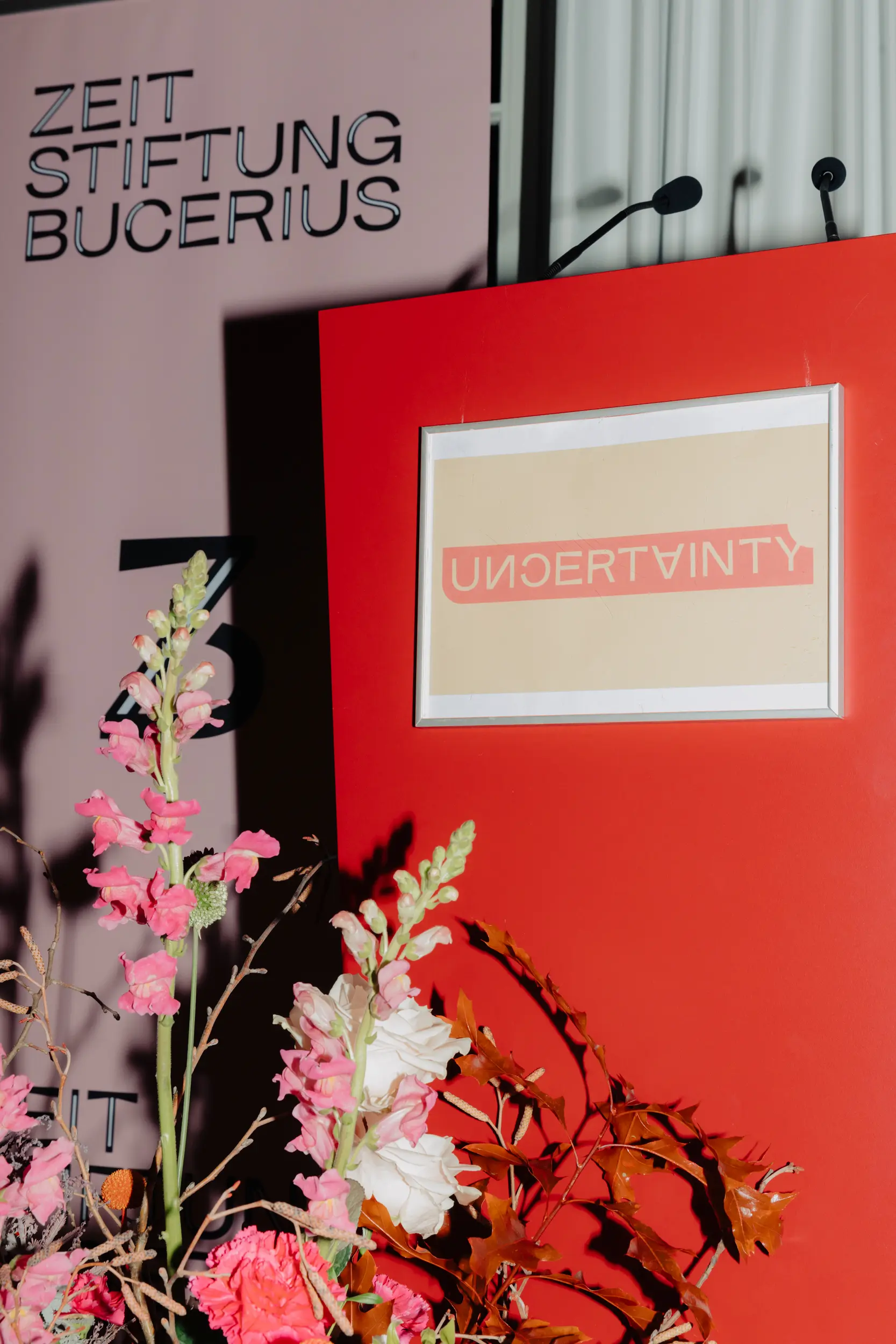
The first on-site colloquium involving “Uncertainty” fellows took place from 22 to 24 September 2025. Under the guiding theme "Examining Uncertainty," twelve international doctoral students from nine countries gathered at Bucerius Law School for their first joint conference. Together, they explored the facets and functions of global uncertainties on both societal and individual levels. The diverse program featured historical analyses, research on geographical border zones, and case studies addressing uncertainty in the context of climate change and migration. Prof. Dr. Andreas Zick (Bielefeld University, “Uncertainty” Advisory Board Member) opened the event with a keynote titled “Looking Beyond the Unknown”. He examined the social functions of uncertainty and methods for studying such functions. The conference concluded with a networking event that brought together the Ph.D. fellows and artists from the ZEIT STIFTUNG BUCERIUS Performing Arts Program, thereby aiming to spark creative collaborations on new aesthetic expressions of uncertainty.
Opening Talk
The opening of the “Uncertainty” program took place on 26 November 2024 with the panel discussion “Uncertainty: On a current diagnosis and ways of coping with turbulent times”. The event addressed the widespread erosion of traditional social, economic, and political certainties. Global challenges—ranging from climate change and armed conflict to the erosion of democracy and rapid technological shifts—have established uncertainty as a defining characteristic of the current era. The discussion highlighted a profound, systemic need for new frameworksacross individual, institutional, and societal levels. The session featured insights from a multidisciplinary panel of experts:
- Dr. Teresa Koloma Beck, Helmut Schmidt University / University of the Federal Armed Forces Hamburg
- Colin von Negenborn, University of Hamburg
- Dr. Shalini Randeria, Central European University, Vienna
You can watch the conference here: here.